Tuesday, July 6, 2010

japanese food: noodles

I think that since sushi is Japan's most popular export to the U.S., some Americans assume that people in Japan eat sushi constantly. On the contrary, much of what we ate on a day-to-day basis was noodle-based. Our first bowl of noodles on our first full day turned out to be one of my favorites.

kimchi ramen in Taito

The ramen is widely available in narrow little bars like the one we visited near our hotel. This bowl of ramen is fairly standard in our short experience, with a thin slice of pork, greens (spinach in this one), and large sheets of nori (seaweed). We enjoyed the addition of some kimchi for spice and crunch.

However, it's the broth that makes the bowl and totally blows any cup ramen out of the water. The broth was salty and complex, giving off smells and tastes of fish, pork, and soy. I would have loved to drink it down completely, but I wasn't sure I could handle the sodium. Anyway, this was an amazing bowl of soup.

ramen with wonton in Naka-meguro

Ramen itself is an import from China and both times we ate ramen it was topped with something foreign (kimchi from Korea and wonton from China). I was surprised by how much sort of "Asian fusion" we ate in Japan.

Another ubiquitous noodle dish is soba. Usually served cold with fried sides, soba are buckwheat noodles that you dip in a self-mixed concoction of soy sauce, ginger, green onions, and wasabi.

soba with tempura shrimp in Shintomi

When we visited friends in the country, we ate at a charming soba place where we watched the noodles being prepared. The noodles were paired with delicious tempura...everything.

cutting the dough

dusting off the freshly-cut noodles

basket of soba in Katsunuma

grating my own fresh wasabi

tempura soba, carrot, sweet potato, mushroom, eggplant, leaves

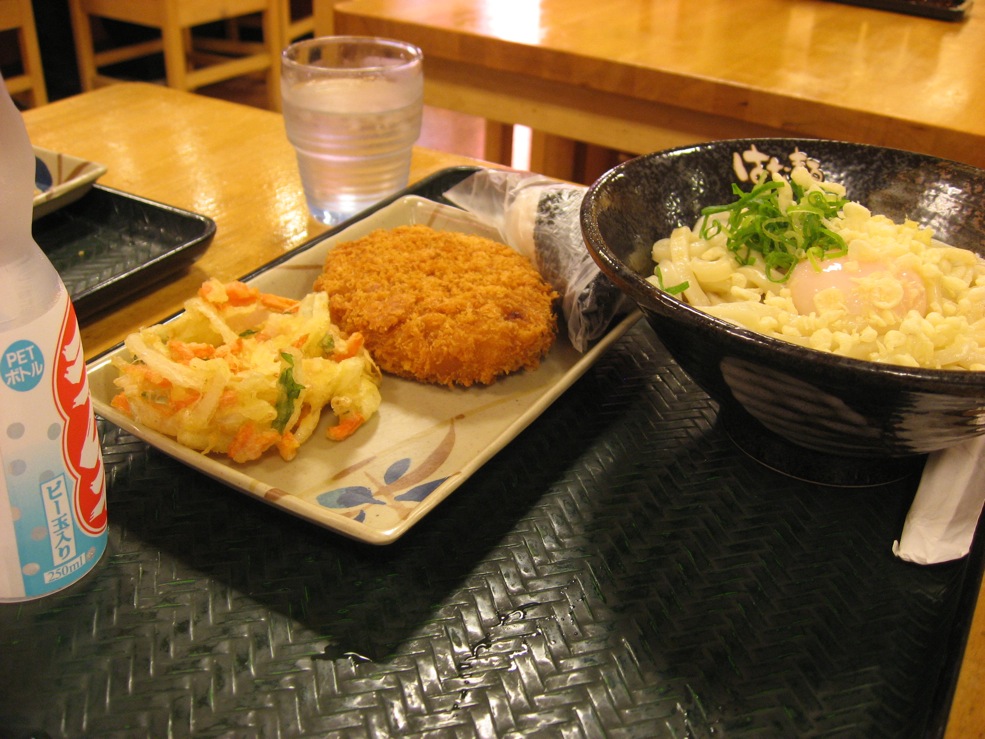
Last but certainly not least we have udon. These are thick, chewy noodles served either in a soup or warm topped with vegetables or a soft-boiled egg. Our friend took us to a Tokyo chain where you order your bowl of ramen, then pick your fried sides from trays cafeteria-style. One of the best parts of udon is being able to top your noodles with tiny tempura crumbles, ginger, spicy red pepper seasoning, sesame seeds, and soy sauce. Why can't fast food in the States be more like this?

in Kichijoji (left to right): kakiage (vegetable tempura fritter), korokke (breaded fried potato cake), udon with egg

udon with pork, tempura fish cake, tofu skin, and soft-boiled egg

I've saved the best for last. This bowl of udon was eaten in a little restaurant in the woods near Mt. Fuji and was the granddaddy of all noodle dishes we ate on our trip. The noodles were especially thick and chewy, apparently a specialty of that area. The tender sweet pork, rich egg, and flavorful broth topped everything off, but those noodles with their ample bite made them one of the more memorable dishes we had in Japan.

udon shop--the line out the door is a good sign!

Monday, July 5, 2010

japanese food: fried food

As we were planning our trip to Japan, I wasn't quite sure what to expect of the food. I mean, I had eaten at the (very American) hibachi place and had tried (with little success) a few sushi rolls. The only Japanese foods I knew for certain that I liked were inari and rice crackers, and I didn't think I could live off of those for 2 weeks. I was a tad bit nervous.

All that changed when we ate our first Japanese lunch and I discovered the wonderful world of fried food in Japan.

tonkatsu, rice, miso, and pickled vegetables

Enter tonkatsu. Matt might deny it, but it seems to me that this could be his favorite Japanese dish. A panko-breaded, fried pork cutlet is dipped in either tonkatsu sauce (a sweet soy sauce) or ponzu. At this particular restaurant we were given a mortar and pestle to grind soy sauce, to which we then added a sauce for dipping.


Very quickly into our trip I knew I loved Japanese fried foods. Towards the end I found something that I think most Midwesterners could enjoy: kushiage. Our friend in Tokyo took us to a great little place in Shinjuku where you could order practically anything breaded and fried. The breading didn't seem to be panko, but it was lighter and crispier than most breading. We carefully dipped each skewer into the communal soy sauce vat (but only once!) and enjoyed the fried goodness.

kushiage (clockwise from top right):
beef, ham, sausages, bacon-wrapped tomato wedge, squid, green onions, garlic cloves, eggplant, lotus root, cheese!


fried banana, ice cream, and apple

Our trip was bookended by tonkatsu lunches (the first one was best though). Our last lunch in Tokyo was in a little mom and pop restaurant between our hotel and the station. We had a huge lunch and more of the sweet Japanese hospitality we enjoyed so much.

tonkatsu

fried ebi (shrimp)

Japan even managed to get me--a self-proclaimed seafood-hater--eating and loving shrimp!

Tuesday, June 29, 2010

japanese food: breakfast

I got back from Japan this past weekend and am beginning to recover from the jet lag. Matt and I took hundreds of photos, many of them food-related. Needless to say, Japanese dishes will be the topic of many upcoming posts.

Let's get started with the first meal of the day!

bacon & egg sandwich
cinnamon set


Our breakfasts at our first inn in Tokyo were Western-style and plenty filling. It was so important to load up in the morning because we were never sure when or where we'd eat lunch.

The photo above shows our favorite combination to order. The sandwich featured a fried egg, cucumber, tomato, and what they called bacon (we would call it ham). The cinnamon set was basically french toast with cinnamon and powdered sugar. It was wonderful to start the day in the cozy, homey lobby at Andon Ryokan.

cold tofu, miso, rice, and pickled vegetables

We were incredibly fortunate to be able to spend a weekend in a Japanese home in the countryside near Mt. Fuji. That was when we had our first experience with a traditional Japanese breakfast. Every day we ate there was a little different, but all had plain white rice, miso soup, and pickled vegetables of some sort. Each breakfast involved large quantities of food that kept me full until lunch or even later. It seemed like quite a lot of work for our hostess each morning compared to what I might make for breakfast in the states, but she seemed to have a routine worked out.

miso, grainy rice with salmon flake, tamagoyaki, and pickled vegetables

The second day I was introduced to one of my favorite breakfast/lunch items, tamagoyaki (which means "fried egg"). Basically a lightly sweetened thin sheet of egg is rolled up and then sliced. This is also a popular item for bento lunch boxes. I intend to attempt making a version myself, but haven't tried yet. I wish I knew the actual names for some of the things I ate. I can just tell you that the rice had some small black beans, black rice, and millet mixed in and it was delicious. The miso soup had some sort of fried strips that softened in the broth like croutons.

grape compote
peach compote


One day we got to partake in grape and peach compotes homemade by our host's mother from fruit grown on their land. It was very sweet with a touch of cinnamon on the peaches. What a special treat!

sauteed eggplant, miso with tofu, rice, tamagoyaki, and aloe yogurt

I was surprised at how tasty aloe yogurt could be! The texture was quite a bit like peach yogurt.

Check back as there will be much more to come including fried foods and sweets.

Thursday, June 10, 2010

what's been cooking

Matt and I are heading to Tokyo on Saturday. That means the next several blog posts will be about Japanese food, hopefully while we're still over there. Before we go, I want to clear out my stash of recently-cooked meals, especially before all the spring/early summer ingredients are gone. The following are all recommended recipes--some have a link to a recipe and some just have the ingredients listed. Enjoy!


burger with horseradish havarti, bacon, caramelized onions, mayo, and greens on pretzel roll


mixed green salad with strawberries, grilled chicken, avocado, spring onions, and Bolthouse Farms mango vinaigrette

three-cup chicken with green beans (no photo)

Wednesday, June 2, 2010

this was really good

asparagus tofu stir-fry (on my cupcake-aproned lap)

Last week we used asparagus and spring onions from our first CSA box of the season to make a tofu-based stir-fry. I took some liberties with the recipe, including leaving out the spinach, basil, and mint (I didn't have spinach or basil and Matt doesn't like mint). I used more garlic than it called for, which was not a mistake.

I also opted for Wildwood brand super-firm tofu instead of the suggested extra-firm. My philosophy when stir-frying tofu is this--the firmer the better. I've had extra-firm tofu fall apart and turn to scrambled-egg texture too many times. Maybe I'm just not gentle enough, but I am a total convert to this Wildwood stuff. It has that lovely firmness that I usually attribute to restaurant tofu.

Do take the recipe's advice to have all your ingredients prepped ahead. This dish fries up quite quickly. Do include the lime zest and juice. It added a nice bit of sweetness and tang.


Asparagus Stir-Fry
adapted from 101 Cookbooks (printable version available through link)

toasted sesame oil
8 oz super firm tofu, cut into strips the width of a pencil
4 green onions, thinly sliced
scant 1 tbsp grated ginger
1/2 tsp crushed red pepper flakes
1/2 lb or bunch asparagus, trimmed and sliced into 1-inch chunks
a couple big pinches fine-grain sea salt
3-4 cloves garlic, chopped
1 big handful cashews, chopped up a bit
a few handfuls of spinach or other greens, optional
zest and juice of one lime
2 tbsp hoisin sauce
1 small handful each slivered mint and/or basil, optional

Have all your ingredients prepped and within arms reach of the stove. Heat a splash of sesame oil in a large pan, or well-seasoned wok over medium high heat. Alternately, you can do this in a dry non-stick pan - one of the few occasions I still use non-stick. When it is hot, add the tofu, and cook until golden - a few minutes. Remove the tofu from the pan and set aside.

Add another (generous) splash of oil to the pan and, as soon as it is hot, add the onions, ginger, red pepper flakes, asparagus, and salt. Stir fry for about a minute, then add the garlic, cashews, and spinach and stir-fry for another minute, or until the spinach wilts. Return the tofu to the pan. Stir in the lime zest and juice and the hoisin sauce. Cook for another 10-20 seconds, stirring all the while.

Remove from heat and stir in the mint and basil if using. Taste and add a bit more salt if needed.

Sunday, May 30, 2010

neapolitan pizza

Ever since we were blown away by Bricks Neapolitan Pizza in my parents' city of Hudson, Wisconsin, Matt and I have sought out the Neapolitan pizzerias in Madison. Neapolitan pizza is characterized by a thin crispy crust and a simple San Marzano tomato sauce baked in a very hot wood-fired oven for about 90 seconds. The oven has to be certified by a committee in Italy in order for the pizza to be authentically Neapolitan (that's where my knowledge ends--I'm certainly no expert).

Despite the similar ovens, the pizzerias we've visited have featured quite different pizzas. The topping options are diverse and will suit various tastes, but the real difference is in the crust. All the crusts are thin, crackery in some places and bubbly in others. The best crust we had was at Bricks: chewy and crusty all over the pie. The worst was probably Cafe Porta Alba, whose crust sagged under the weight of the tomato sauce.

Bricks

our winner: Bricks' "Gusto"

Bricks offers creative topping combinations on either a red or white sauce with hand-stretched mozzarella. One of my favorites includes goat cheese, bacon, artichoke hearts, and red onion on the red sauce. Last time we visited we had one with melty gorgonzola, prosciutto, red onion, and red bell pepper. We enjoyed the foccacia di Bricks with Parmesan, rosemary, and olive oil. We were also lucky enough to receive a free salad that had been ordered for take out and abandoned. Named the "Mista", it was a truly delicious combination of greens, bacon, cherry tomatoes, artichoke hearts, Parmesan, and a Vidalia onion vinaigrette.

foccacia di Bricks

"Mista" salad

Pizza Brutta

I really enjoyed the topping options at Pizza Brutta in Madison, which I have posted about before. They also offer both red and white sauces. Matt was not happy with the softness of the crust, but it still had a nice char on it. I would like to try it again. It's a nice, casual place with very fast pizza if you're in a hurry.

the "Diavola": mozzarella, spiced salami, red pepper flakes, and pepperoncini

Cafe Porta Alba

The menu is somewhat more simple at Madison's Cafe Porta Alba. We ordered a buffalo mozzarella pizza and added salame. It was really too simple for our tastes. Our friends had the "Vegetariana". If we went again, I might try the "Alifana" with mozzarella, tomato, basil, artichokes, and salame.

buffalo mozzarella & salame

the Vegetariana

Lombardino's

Finally, Matt also had a Neapolitan-style pizza at Lombardino's Restaurant. This one was fine, but not outstanding. However, Lombardino's pasta dishes are quite nice and their atmosphere is really kitschy and homey.


In the end, we've decided that Bricks' pizza is worth waiting to visit my parents for, but if we're craving Neapolitan pizza in Madison, we'd give Pizza Brutta another try.

Tuesday, May 18, 2010

best dessert invention yet

We've always enjoyed the pies, cakes, and shakes at Monty's Blue Plate Diner in Madison. This time they've outdone themselves.

donut sundae

Take two cake donuts. Slice them in half and then slap them on a griddle. Sandwich creamy custard between the double-fried donuts. Add a drizzle of maple syrup and a mountain of whipped cream. I want to eat this again soon.