Showing posts with label Japan. Show all posts

Monday, March 28, 2011

nickels and anchors

I haven't done a wardrobe post in a long time, and I really haven't taken any shots of my outfits lately, but I happened to get some pictures at a nickel arcade in Chicago last weekend.


I made Matt stop taking pictures of my slack-jawed concentration face and catch my outfit.


dress - Zara in Tokyo
tights and cardigan - Target
boots - Good Style

The arcade was the greatest place to spend the afternoon!  Tetris and PacMan for free and skee ball for nickels.  My dress was perfectly comfortable for playing skee ball and had great big pockets for nickels! 


We finished the night off with a nice dinner with friends.  This was the only shot of the front of the dress, with its cute little anchor buttons.  I picked up the dress in Shibuya last summer at Zara--pretty much the only affordable place in that neighborhood.  Nautical style was everywhere, so there were lots of tempting pieces.  I still sort of regret not buying an oversized T-shirt with a huge anchor.
Lucy & me

Tuesday, March 22, 2011

tv dinner

So, I've already missed my goal of blogging every day during break.  Last night the internet was out for awhile in the evening, and then I fell asleep on the (very orange) couch.  Oh well.


I had already enjoyed Makiko Itoh's Just Bento and Just Hungry websites, so when Serious Eats posted recipes from her Just Bento Cookbook, I was ready to jump on the chance to try some reliable and fairly simple Japanese recipes.  By the way, I just found out that Makiko lives what must be an amazing life split between Japan, Switzerland, and Southern France.  Wow.


My first foray into Just Bento recipes was Chicken Karaage - Japanese fried chicken.  I typically avoid frying foods at home, but this sounded too great to pass up.  Unfortunately for my health, but fortunately for my taste buds, this frying adventure led to several more fried dishes in the following weeks.

The recipe called for boneless chicken thighs, which I was unable to find, so I struggled with pulling the bones out of a package of thighs.  I do recommend using thighs, despite the hard work.  All the fatty strains liquefied and just made the already juicy dark meat even more succulent.  I opted to leave the skin off this time, but I'm sure my husband would have appreciated the inclusion of the skin.

The chicken karaage was meant to be a bento meal for the following day's lunch, but after our first bite, we couldn't stop eating until it was all gone.  Best TV dinner ever.


Chicken Karaage
from the Just Bento Cookbook by Makiko Itoh via Serious Eats

This recipe was intended for one serving for a bento lunch.  I quadrupled the recipe to use a 1-lb package of chicken thighs and it served two, although it could serve more if you are not as gluttonous as we were!  We dipped our chicken pieces in green onion sauce as we ate them, but I'd be interested to see what the texture would be like if I followed the directions and dipped them right after frying.

1 lb boneless chicken thigh, with or without skin, cut into 3–4 pieces  
4 tsp soy sauce (if you are not making the green onion sauce, increase to 2 tsp) 
4 tbsp sake 
4 tsp peeled and grated fresh ginger 
vegetable oil, for deep-frying 
8 tbsp cornstarch (or enough to cover chicken pieces)
handful green salad leaves or other vegetable
cooked short-grain rice
For the green onion sauce: 
4 tbsp rice vinegar 
4 tbsp soy sauce 
4 tbsp finely chopped green onion
Pinch sugar
A few drops sesame oil  
4 tsp peeled and grated fresh ginger

Combine the chicken, soy sauce, saké, and ginger. Let marinate for at least 10 minutes or overnight. (If you need to leave it marinating for more than 12 hours, omit the soy sauce and add it 10 minutes before cooking, or the salt will draw out too much moisture from the chicken and make it dry.)
 
Remove the chicken pieces from the marinade, drain, and coat in the cornstarch.

Heat 1 inch (2.5cm) of vegetable oil in a saucepan over medium-high heat. Test the oil temperature by putting a little of the cornstarch-and-marinade coating on the end of a wooden chopstick and dipping it into the oil. If the coating sizzles and turns brown immediately, the oil is hot enough. If the oil starts getting smoky, turn down the heat.

Fry the chicken pieces in the oil, turning once, until a deep golden brown. Drain well on paper towels.

To make the green onion sauce, combine all the ingredients in a small frying pan over medium heat and stir until the sugar is dissolved. Put the chicken pieces in the pan and toss to coat each piece with the sauce.

Let cool completely before packing into a bento box. Putting a layer of arugula or other salad leaves under the chicken enhances the color of the chicken and provides another texture in the bento.

Note from Serious Eats: You can cook chicken karaage the night before. If I’m making this for dinner, I usually set aside a few pieces for the next day’s bento. Chicken kara-age can be frozen uncooked and marinated, or cooked. To freeze it uncooked and marinated, put the chicken and marinade (excluding the soy sauce) into a freezer bag. Defrost in the refrigerator in a bowl, adding the soy sauce before frying. Cooked frozen pieces can be defrosted in the refrigerator, then crisped up for a few minutes in a toaster oven. I don’t recommend defrosting cooked pieces in a microwave, since this will make the chicken tough. 

Monday, July 19, 2010

japanese food: izakaya

One of the greatest opportunities we were given in Japan was to attend an enkai (office party) of our host's fellow teachers, unwinding on a Friday evening. Not only did we get to try many new foods, we had a blast at the noisy festivities. We met up with them in progress at an izakaya, which is basically a Japanese pub. There was already food on the table and much more to come.

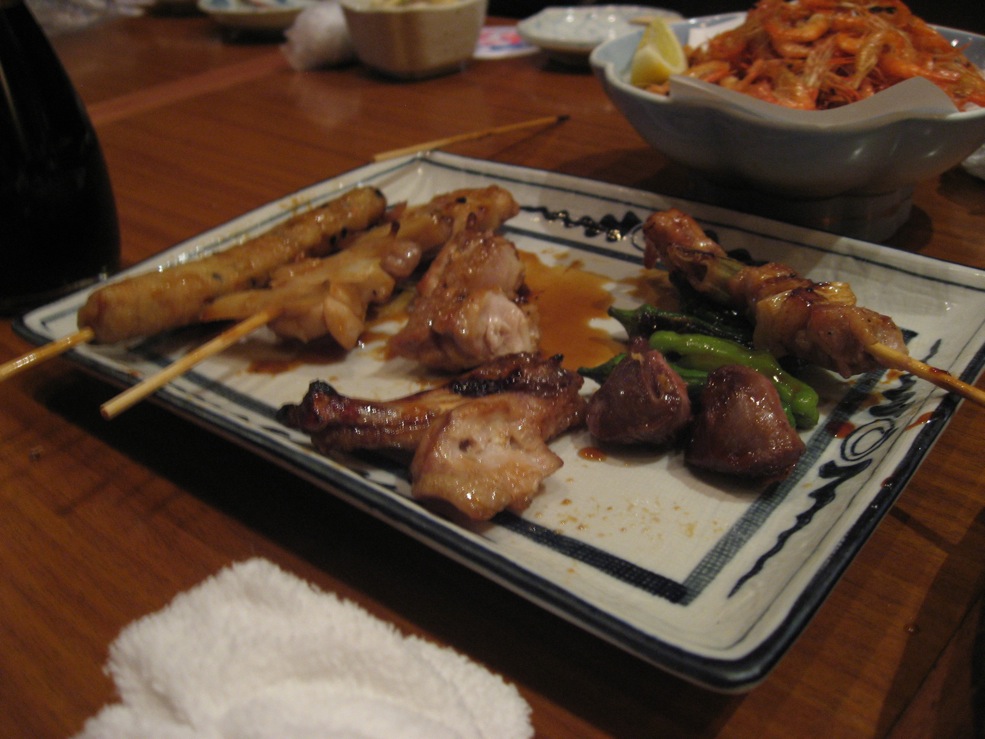
We started with yakitori, a common type of Japanese bar food involving chicken or some other meat and veggies grilled on skewers, and sashimi, or raw seafood.

yakitori (clockwise from left): fish cake, chicken tendon, chicken & green onion, tiny green peppers, chicken hearts, chicken wings

sashimi: hamachi, scallop, squid, shrimp, tuna

Drinking is also a huge part of the enkai, so an overflowing glass of sake was a necessity.

sake

The sake was followed by what seemed like an unending barrage of delicious foods.

"Have you ever tried (insert food name here)?"

"No."

"Let's get some."

korokke: breaded & fried potato pancake

nigiri sushi (from left): tuna, hamachi, salmon, squid, tamago (egg)

breaded & fried baby octopus

shabu-shabu

Shabu-shabu was a revelation. Very thinly sliced & perfectly marbled beef, cabbage, and mushrooms are quickly dipped in hot broth until gently cooked. Grab some beef, swish for 3-5 seconds, then remove and drag through ponzu (we think) for the most tender and flavorful piece of meat.
dunking the shabu-shabu

Perhaps the most surprising offering at the izakaya was horse-meat sashimi, a specialty of Yamanashi. Matt partook in the chewy raw horse-meat and was glad he tried it, though he says he would not go out of his way to eat it again. In the interest of full disclosure, I did not try it at all.
horse-meat sashimi with wasabi, ginger, & green onion

We felt fortunate to be a part of the enkai, to commiserate with other teachers, and to experience an important event in Japanese work culture. That evening left us with some lovely memories.

the aftermath

Friday, July 16, 2010

japanese food: donuts

We headed to Japan with many things that we wanted to eat. Among our culinary priorities loomed Japan's gourmet donuts. Donuts were everywhere in Tokyo; it seemed as though a Mister Donut chain was on every corner. We never did get around to eating at Mister Donut, but we were not disappointed by the smaller donut shops that we patronized.

First we searched for (and found) Hara Donuts in Shimokitazawa. Like most shops in this area, it was tiny and super cute.


We opted for three varieties: plain, tomato, and grapefruit. None of them were overly oily or too dense. Similar to a cake donut but lighter, Hara's donuts were subtly sweet and a bit chewy. The grapefruit, with its citrus-y glaze, was my favorite by far. The tomato was not as weird or as interesting as we had hoped as it was somewhat bland and also tougher than the other two.

hara donuts: grapefruit, plain, and tomato

When visiting Yamanashi Prefecture, we had hoped to visit Sendaiya Donuts, whose claim to fame is making treats out of ground natto flour. Using natto, a fermented soybean product, is apparently an attempt to make the sweets more healthy.

When our hosts took us to their friends' house, we were offered two unexpected items to sample: Sendaiya's donuts and natto.

natto

Natto smells like a strong cheese and tastes (to our American palates) somewhat like coffee. The texture is unlike anything I'd ever had before: think baked beans suspended in phlegm. Matt was not a fan to say the least, while I thought it paired nicely with some kimchi or spicy mustard. I've also seen it served with rice, which I would definitely try.

I will not be eating natto every morning for breakfast as does one person we met, but I will certainly gobble up some natto donuts from Sendaiya at any chance I get.

sendaiya donuts: sesame, plain

These donuts were dense and moist, much like a pound cake (which we saw on many menus). Like Hara donuts, Sendaiya's are also lightly sweetened and fried compared to American donuts.

We saved the best for last...drumroll, please!


In the last few days of our trip, we headed to Yoyogi-Uehara in the rain, specifically to try Harrits Donuts.

harrit's donuts: milk tea & precious little packages


Staying with the trend of the donuts we tried, these were subtle, light, and tended toward being a healthier breakfast treat. The texture was somewhere between a cake and raised donut and even resembled a pastry somewhat.

cinnamon cranberry donut

kinako (soybean flour) donut

cream-cheese-filled donut...ichiban!

Along with the flavors we tasted in the store, we also took some home in our carry-on to share with family. Those included carrot-honey, kiwi, green tea with Azuki bean paste, and more of our favorites, kinako and cream cheese.

I would recommend any of these donut shops without reservation. If you're ever in the area, it's worth seeking them out!

If you have tried Mister Donut, I'm curious: did we miss out?

Wednesday, July 7, 2010

japanese food: osaka specialties

I won't attempt to deny that there were a lot of Japanese foods that I did not expect to try. I never, ever thought that I could handle a ball of fried dough with a piece of octopus tentacle inside. I mean, the fried dough part sounds great, right? I just didn't know what I'd do once I got an octopus arm in my mouth. Turns out I'd chew it (for awhile) and love it.

takoyaki

Takoyaki are little lava-hot spheres (think half-cooked pancake balls) that burst open when you bite them, revealing a mildly fishy, quite chewy bit of octopus. They are topped with a barbecue-like sauce, then mayo, and typically katsuobushi (fish flake) and aonori (seaweed flake).


Takoyaki hail from Osaka, as do the gentlemen who prepared them inside this pink VW bus. Matt spotted this stand in Shimokitazawa and decided it should be the place for us to lose our takoyaki virginity. They were proud to have a couple of gaijin (foreigners) eating behind their stand.

And I do mean behind...


I think they had a great little set-up.

Possibly my very favorite food that I tried in Japan turned out to be a dish from Osaka. Okonomiyaki is a Japanese pancake that is similar to takoyaki in that it is topped with the same sauces and sprinkles, but is much easier to eat due to the absence of molten dough. Our friends in Tokyo took us to a great little place for our first experience with okonomiyaki.


First, mix your ingredients that include egg, cabbage, meat, and veggies...


Then fry it on the griddle in the center of your table...

"Sakura-yaki": shrimp, squid, pork, white onion, green onion, and mushrooms topped with a fried egg and bacon strips

And top with okonomiyaki sauce, mayo, katsuobushi, and aonori. Share with your friends!

pork & kimuchi okonomiyaki

I was such a fan of okonomiyaki, I may get brave enough to try it at home! I'll let you know how that turns out...

Tuesday, July 6, 2010

japanese food: noodles

I think that since sushi is Japan's most popular export to the U.S., some Americans assume that people in Japan eat sushi constantly. On the contrary, much of what we ate on a day-to-day basis was noodle-based. Our first bowl of noodles on our first full day turned out to be one of my favorites.

kimchi ramen in Taito

The ramen is widely available in narrow little bars like the one we visited near our hotel. This bowl of ramen is fairly standard in our short experience, with a thin slice of pork, greens (spinach in this one), and large sheets of nori (seaweed). We enjoyed the addition of some kimchi for spice and crunch.

However, it's the broth that makes the bowl and totally blows any cup ramen out of the water. The broth was salty and complex, giving off smells and tastes of fish, pork, and soy. I would have loved to drink it down completely, but I wasn't sure I could handle the sodium. Anyway, this was an amazing bowl of soup.

ramen with wonton in Naka-meguro

Ramen itself is an import from China and both times we ate ramen it was topped with something foreign (kimchi from Korea and wonton from China). I was surprised by how much sort of "Asian fusion" we ate in Japan.

Another ubiquitous noodle dish is soba. Usually served cold with fried sides, soba are buckwheat noodles that you dip in a self-mixed concoction of soy sauce, ginger, green onions, and wasabi.

soba with tempura shrimp in Shintomi

When we visited friends in the country, we ate at a charming soba place where we watched the noodles being prepared. The noodles were paired with delicious tempura...everything.

cutting the dough

dusting off the freshly-cut noodles

basket of soba in Katsunuma

grating my own fresh wasabi

tempura soba, carrot, sweet potato, mushroom, eggplant, leaves

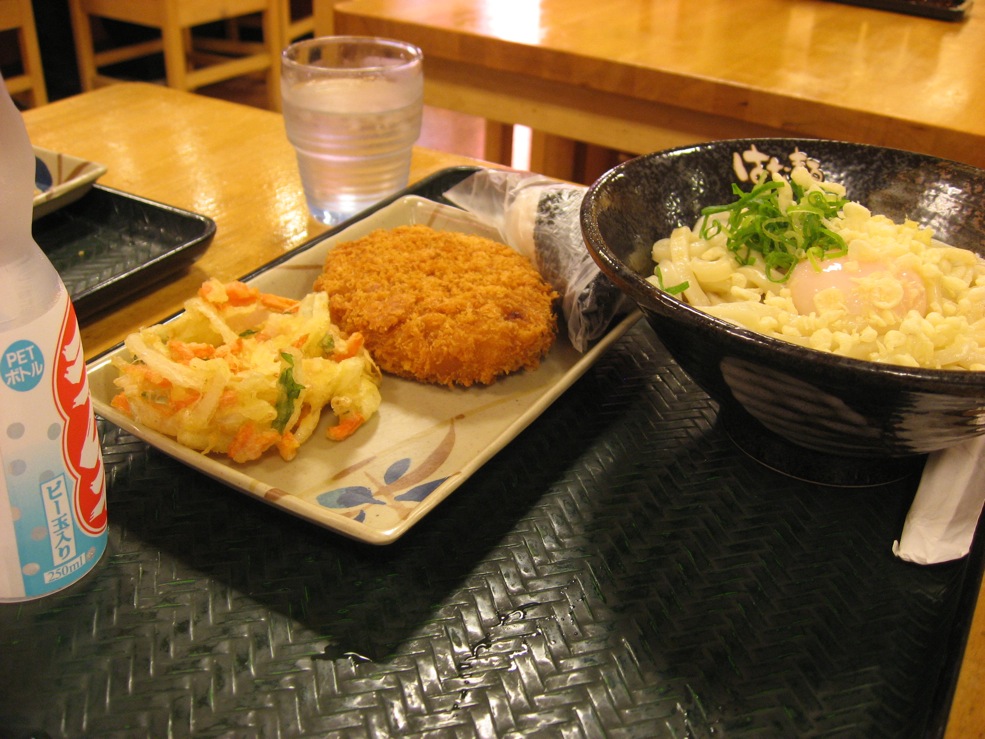
Last but certainly not least we have udon. These are thick, chewy noodles served either in a soup or warm topped with vegetables or a soft-boiled egg. Our friend took us to a Tokyo chain where you order your bowl of ramen, then pick your fried sides from trays cafeteria-style. One of the best parts of udon is being able to top your noodles with tiny tempura crumbles, ginger, spicy red pepper seasoning, sesame seeds, and soy sauce. Why can't fast food in the States be more like this?

in Kichijoji (left to right): kakiage (vegetable tempura fritter), korokke (breaded fried potato cake), udon with egg

udon with pork, tempura fish cake, tofu skin, and soft-boiled egg

I've saved the best for last. This bowl of udon was eaten in a little restaurant in the woods near Mt. Fuji and was the granddaddy of all noodle dishes we ate on our trip. The noodles were especially thick and chewy, apparently a specialty of that area. The tender sweet pork, rich egg, and flavorful broth topped everything off, but those noodles with their ample bite made them one of the more memorable dishes we had in Japan.

udon shop--the line out the door is a good sign!

Monday, July 5, 2010

japanese food: fried food

As we were planning our trip to Japan, I wasn't quite sure what to expect of the food. I mean, I had eaten at the (very American) hibachi place and had tried (with little success) a few sushi rolls. The only Japanese foods I knew for certain that I liked were inari and rice crackers, and I didn't think I could live off of those for 2 weeks. I was a tad bit nervous.

All that changed when we ate our first Japanese lunch and I discovered the wonderful world of fried food in Japan.

tonkatsu, rice, miso, and pickled vegetables

Enter tonkatsu. Matt might deny it, but it seems to me that this could be his favorite Japanese dish. A panko-breaded, fried pork cutlet is dipped in either tonkatsu sauce (a sweet soy sauce) or ponzu. At this particular restaurant we were given a mortar and pestle to grind soy sauce, to which we then added a sauce for dipping.


Very quickly into our trip I knew I loved Japanese fried foods. Towards the end I found something that I think most Midwesterners could enjoy: kushiage. Our friend in Tokyo took us to a great little place in Shinjuku where you could order practically anything breaded and fried. The breading didn't seem to be panko, but it was lighter and crispier than most breading. We carefully dipped each skewer into the communal soy sauce vat (but only once!) and enjoyed the fried goodness.

kushiage (clockwise from top right):
beef, ham, sausages, bacon-wrapped tomato wedge, squid, green onions, garlic cloves, eggplant, lotus root, cheese!


fried banana, ice cream, and apple

Our trip was bookended by tonkatsu lunches (the first one was best though). Our last lunch in Tokyo was in a little mom and pop restaurant between our hotel and the station. We had a huge lunch and more of the sweet Japanese hospitality we enjoyed so much.

tonkatsu

fried ebi (shrimp)

Japan even managed to get me--a self-proclaimed seafood-hater--eating and loving shrimp!